
 D-Day, Overlord and Normandy beaches remain indelibly marked in the memories of many whose relatives took part in or were affected by World War 2. None more so than those who are linked to Normandy itself. But why should we still remember it? Churchill captured the answer to that question in a simple phrase, El Alamein was the “end of the beginning” and D-Day, 6 June 1944, was the “beginning of the end”.
But, why there? For both French and British school-children, the answer to that question, too, is simple. The Normandy coast was the access point for invasions by the English for over a century during the ‘100 years war’.
So, why then? The original assault was planned for June 5th, but had to be abandoned due to atrocious weather. June 6th offered a short break in the storm. Eisenhower took the gamble.
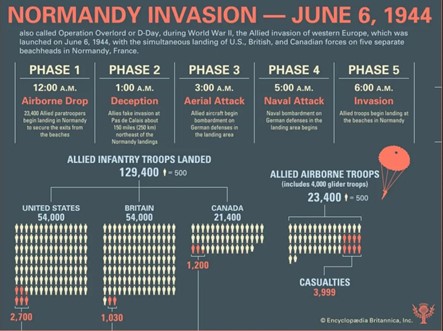
While June 6th 1944 is remembered world-wide, the invasion did not begin that day. It began on the night before with Operation Neptune – an airborne drop of USAF 101st (the ‘Screaming Eagles’) and 82nd Airborne paratroopers to secure the roads away from the beaches. This was followed by a fake invasion, named Operation Titanic, on June 5th 1944. Titanic, with the help of 200 dummy paratroopers, succeeded in convincing the German command that Operation Overlord had started to the north of the river Seine and was not going to happen on the Normandy Beaches.
The beaches themselves have been spared any significant development since 1944 although the cliffs behind them still carry the scars of the battle and the semi-derelict remains of the ‘Atlantic Wall’ fortifications erected by the Germans during the occupation. Clearing the D-Day landing beaches continues with around 1,000 de-mining operations each year to the present (2006[1]) Fortunately, it is unlikely to experience any future damage as the beaches are now proposed to become a World Heritage[2]e site.
But, have you ever wondered what they were like before the war or before D-Day? The coast itself had been developing as a string of small beach resorts since the 1890s. Just inland, it was mainly an agricultural area, essentially similar to the activities that a modern visitor sees. The beaches were named after the nearest local village and strung along them were villas, small restaurants and a few hotels. Those village names have now been replaced with their unlikely D-Day code names.
The beaches assigned to the US forces, Utah (near St. Marie du Mont) and Omaha (near Vierville), were named from the birth states of two junior officers selected at random. The three beaches assigned to the British, Gold (Vers-sur-Mer), Juno (St. Aubin) and Sword (Ouistreham), were named after species of fish: goldfish, swordfish and jellyfish. Jelly was changed to Juno after the name of the wife an officer.
Utah Beach is the most westerly beach of Operation Overlord. It corresponds to Madeleine beach, in Sainte-Marie-du-Mont (Manche), between Pouppeville and La Madeleine, three miles long, and was assigned to the U.S. 1st Army, 7th Corps. Casualties were the lightest of all landings – out of 23,000 troops, only 197 men were killed or wounded. It was added at the last moment to the Allied plan, with the aim of seizing the port of Cherbourg, the only deep-water port in the area that could allow for the unloading and the supplying of troops.
Nicknamed “Bloody Omaha”, the 6 km beach between Sainte-Honorine-des-Pertes and Vierville-sur-Mer, was one of the most difficult places for the Allies. Taking Omaha was the U.S. 1st Army, 5th Corps’ responsibility, with sea transport from the U.S. Navy and elements of the Royal Navy. The American battalion of 54,000 almost failed: the amphibious tanks were launched too early; the first wave of assault was mowed down contributing to a loss of life was 2,700.
Gold Beach ran from Longues-sur-Mer to La Rivière, five miles long and included Arromanches where the Mulberry Harbor was established. It is in the centre of the landing zone. British 2nd Army, 30th Corps landed here and by night-fall, 25,000 troops had pushed the Germans six miles inland. The British had just 400 casual-ties.
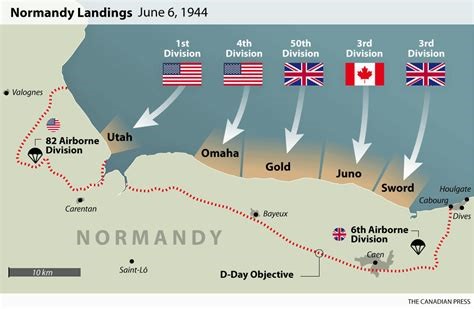 Juno Beach runs from Saint-Aubin-sur-Mer, through Bernieres and Courseulles-sur-Mer to La Riviere. Despite the bombing, the German cannons were still in good condition upon the arrival. Out of the 21,400 Canadian 3rd Infantry Division and British 2nd Army, 1st Corps who landed, 1,200 were injured in the first hour of assault, but managed to free the planned coastal area. The soldiers joined forces with the British troops of Gold.
Sword Beach stretches five miles from Saint-Aubin-sur-Mer to Ouistreham at the mouth of the river Orne. In this most easterly zone, Force S was made up of General Rennie’s 3rd Infantry Division. Their goal: to join the Juno Beach troops and capture Caen. Among the troops of Sword Beach, were also the No. 4 Franco-British commando, which landed under the command of Commander Kieffer. 177 young Frenchmen volunteered alongside the Allies.
More than US, UK and Canadian Troops were involved
History has erased more than the original names of the beaches. While we are well-informed that over 129,000 Allied troops landed on the first day, and over 800,000 by the end of June 1944, the nationalities of smaller groups of soldiers and civilians who fought have been forgotten. On Sword beach, 177 young French soldiers volunteered alongside the Allies and fought in No. 4 Franco-British commando. Dutch sailors and Polish airmen were also directly involv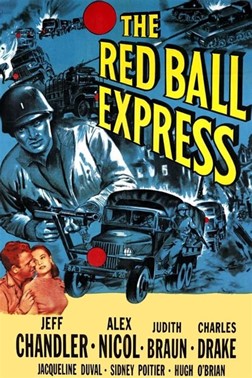 ed in transporting and protecting the troops on their way to the beaches. The actions of the French Resistance in preparing for and supporting D-Day has been sadly overlooked. It’s difficult to say how many were involved but the French Resistance[3] carried out around 1,000 acts of sabotage and 124 were killed or captured in Operations Blue, Red, Yellow, Violet, Turtle and Green to support D-Day.
Is there a reason why the bravery of so many smaller contributors been over-shadowed? My guess is that the memory of what happened on D-Day in particular, and the war in general, is bound up with how quickly and by whom the events were memorialised in film[4]. While film-makers from the US and Italy were releasing films by 1945, Germany by 1948, France by 1949 and Britain by 1951, it took until 2010 for a Canadian film to describe what happened to their troops on Juno Beach (‘Storming Juno’). By then, the narrative presented by US and UK film-makers had set people’s expectations and understanding of the events.
But diminished, if not intentionally forgotten, is the story of the contribution of African-American troops who landed on D-Day and afterwards. Keeping in mind that the US Army was racially segregated until 1948[5], non-white troops were mostly not allowed to be in front-line fighting units and, in any case, non-white officers could not command ‘white’ troops. In the main, non-white troops were restricted to support roles: transport, medics, construction units and so on. And, no matter how heroic, none are recorded as being awarded a ‘Medal of Honour’, even after being nominated. That’s not to say that there weren’t any non-white pilots and air-crew or officers
So, there is a special irony in the casting of the 1952 US film “Red Ball Express”. This film memorialises the contribution made by the truck supply operations that hauled supplies and ammunition from the Normandy beaches, later other deep-water ports, to fighting troops across north, west and south across Europe. In the film, Sidney Poitier plays the solitary ‘black’ member of the driving team. In reality, over 90% of the truck drivers were African-Americans. Back then, truck driving was a racially segregated trade in the US Army.
[1] https://bibliomines.org/document/service-du-deminage/
[2] https://normandiepourlapaix.fr/en/d-day-beaches-world-heritage-site
[3] https://www.dday-overlord.com/en/battle-of-normandy/resistance
[4] https://www.themoviedb.org/keyword/9156-d-day/movie?sort_by=primary_release_date.asc
[5] https://en.wikipedia.org/wiki/Military_history_of_African_Americans